

If you aspire to become a tow truck driver, you should know there’s more to it than hauling broken-down vehicles.
This job requires a blend of specialized training, certification, licensing and experience to succeed — as well as interpersonal skills and sufficient physical fitness. Being a tow truck driver takes hard work and dedication. Many drivers would be stranded on the road without towing professionals.
If you want to know how to become a tow truck driver, the following guide contains handy FAQs showing you what it takes.
Towing professionals help with various situations, including abandoned cars, vehicle breakdowns, car accidents, illegal parking, impoundment and roadside assistance. The job may involve traversing and navigating all sorts of roadways, from windy country roads to jam-packed highways to steep hills and mountains to bustling city streets.
Regulations related to being a tow truck driver vary from state to state in the U.S. Most need you to pass a series of tests and licensing programs. Once you pass, you will then be eligible to operate a tow truck. Contact the U.S. Department of Transportation if you’re unsure what your state calls for. They can point you to the specific laws and guidelines for your state. You may need certifications for both states if you work in an area that closely borders another state.
Basic stipulations of becoming a tow truck driver include:
Please review the following details to see if you meet the prerequisites for becoming a tow truck driver.
You must be at least 18 years old to operate a tow truck. However, many companies require several years of experience on the road — making the typical age to begin a tow truck driving career between 21 and 25.
A truck driver’s education requirements largely depend on their potential employers rather than any established standard. It is not a requirement to have a specific education, but many employers like to see at least a high school diploma or a GED.
Towing is a demanding job. Companies want to know that you have what it takes to perform this position’s physical duties and be safe on the road. Before being hired, you may be required to take a physical exam to ensure you’re in good health, including a hearing and vision test and a drug screening.
You should be able to lift and operate heavy equipment such as tow chains and tires. Can you work in various weather conditions? Can you drive in different elements like snow, rain, hail and wind? What about shoveling out a car that’s snowed in? A tow truck job requires mental and physical endurance.
When it comes to vision and hearing, can you see long distances and navigate through tricky traffic patterns? Do you have good eyesight for short and long distances to hook up cars and maneuver equipment? Excellent hearing is also essential when working at an accident site or other busy area.
Some employers may even require that you take a drug test to become a tow truck driver. They’re looking to see if you’re drug-free since heavy machinery is a central component of the profession.
You must have a state-issued driver’s license and a driving record that shows your reliability and safety on the road. Do you have a history of speeding, traffic violations or DUIs? Your file will show employers how you handle the road and if you practice safe driving.
Sometimes, your employer may run a criminal background check because you have the potential to be in charge of moving people’s valuable possessions. While the car itself is expensive, the items inside may be valuable as well. You must be a trustworthy tow truck driver to move cargo from one place to another safely. Some states may require you to get fingerprinted.
Some drivers train at vocational schools or local community colleges. Specialized courses in towing and recovery combine fundamental knowledge with practical training to prepare you to be a safe and efficient tow truck driver.
New tow truck drivers can also learn skills while on the job through apprenticeship or shadowing. Learning from skilled drivers through on-the-job training is one of the best ways to learn about a company’s policies, safety procedures and strategies. While there may not be any educational background needed, you can gain experience and then seek certification. From there, your certification verifies that you learned the essential skills to advance your tow truck driving career.
You can also communicate with other tow truck operators to find out what companies and firms offer the best training in your area. If you move from one towing business to another, each will train you as a new employee so that you understand their policies. Even when you complete your training, licensing and certification goals, continue taking classes and state-specific educational courses to keep yourself current.
If you meet these basic prerequisites, what next? Licensing and certification are the next stages in pursuing your tow truck driving goals.
While no law states you need a license to become a tow truck driver, the federal law — according to the United States Department of Transportation — says you must hold a commercial driver’s license, CDL, before towing more than 26,000 pounds.
While licensing depends on various state regulations, most states require a CDL license before you can obtain a towing job — regardless of how much they tow.
You can acquire a commercial driver’s license through in-person training, plus a written exam. Once you pass the driver’s test, you have a massive competitive advantage when looking to be hired. You also become a more versatile candidate.
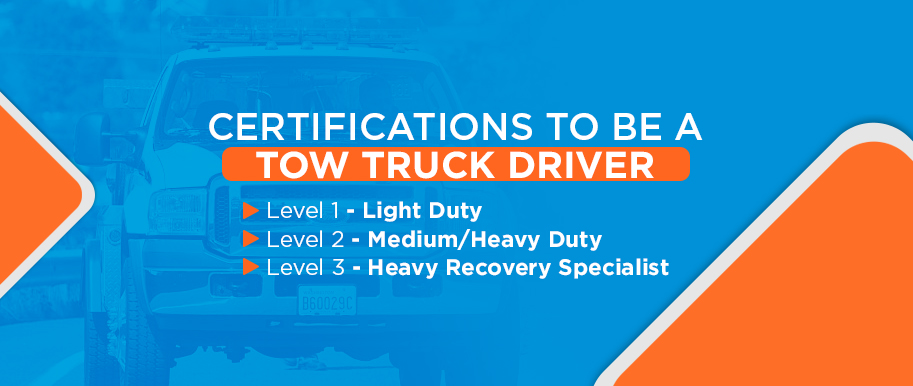
When ready to take the next stride in your tow trucking career, you can obtain your certification in person or online through the Towing and Recovery Association of America (TRAA). The certification program is available for those who already have experience in towing. TRAA creates national standards for tow truck drivers, and the training covers aspects like customer service, safety, equipment, truck maintenance and incident management.
Three levels of certification exist:
Lift and Tow suggests continuing your certification until you reach the third and final tier. It will help you become a well-rounded tow truck driver who’s capable of responding to a variety of jobs. Not sure which license you need? See CDL requirements for tow truck drivers.
There are three types of tow trucks that tow truck drivers typically operate. While you often have one assigned to you, it’s important to know the limitations and operations of each if you start working your way up to more complicated tasks.
Also known as a hook and chain truck, conventional towing vehicles are what most people think of when they picture a tow truck. The truck wraps its chains around a vehicle’s axle and frame while the back arm lifts the car to where the back or front two tires lift off the ground. With the vehicle in neutral, you have an easy towing rig.
Conventional towing machines are less popular than other types because the chains can scratch car paint. However, they are a popular choice when accidents occur. A conventional solution cannot be used to tow all-wheel drive vehicles because the towing device can damage the driving system.
Like conventional tow trucks, the wheel lift — or full float truck — has a metal yoke that raises one of the car’s axles, lifting either the front or back tires off the ground. However, instead of chains, hydraulics suspend the truck or car to prevent damage.
Also referred to as rollback trucks, flatbeds are ideal for expensive vehicles or vehicles with excessive damage that prevents the wheels from rotating. They use a hydraulic system to lower and raise a car or truck bed onto the ramp.
It all comes down to one final question — what does becoming a tow truck driver take? Plain and simple, it’s hard and dirty work. Yet, if you have the right personality type, it can be quite rewarding. Here are some traits and skills that will serve you well if you become a tow truck driver.
To start your career as a tow truck driver, apply to tow companies, service stations or auto salvage businesses. You can also look at state employment services, newspaper ads and internet job sites.
In 2024, a typical tow truck driver’s salary in the United States was $20.25 per hour. Of course, a lot of factors can influence your salary, including:
Yes — if you want to start your own towing business, Lift and Tow can help translate your goals into reality. Let us talk with you one-on-one about what you’re looking to accomplish. Our experts will help you determine which towing product best fits your application and budget.
Any of our repo wheel lift solutions can transform your vehicle into a full-service tow truck. Available in various models, our wheel lifts can be installed on three-quarter-ton trucks as well as bigger pickups. They attach to the underbody of your vehicle and can easily be concealed when you’re not working. We will help you choose between our towing kits.
Once you have a tow truck ready at the turn of your key, you can start building your business by filling out the appropriate paperwork for your state. If you want to be a single operator, that is an option. But if you build a startup, you will also want to consider how you’ll grow your fleet, hire employees and make your mark on the community.
Before starting your towing business, be sure to research your area. Towing may be the perfect business opportunity for you — yet it requires careful planning and compliance with a variety of licensing and regulatory conditions. Consider consulting with a legal professional who can advise you on local jurisdiction requirements. Many states and cities mandate specialized licenses and permits, which could include:
Once you have all the necessary licenses and permits, you can operate legally and successfully in the towing industry.
Before you begin, review OSHA requirements for tow truck drivers.
At Lift and Tow, our tow systems offer fast and efficient loading, incredible durability and versatility when towing various kinds of vehicles. Our solutions help you avoid buying an entire towing rig and allow you to convert your truck into a multipurpose vehicle.
Check out our wheel lift units including the Super Series, 5-Series and Z-Series wheel lifts to get started.